

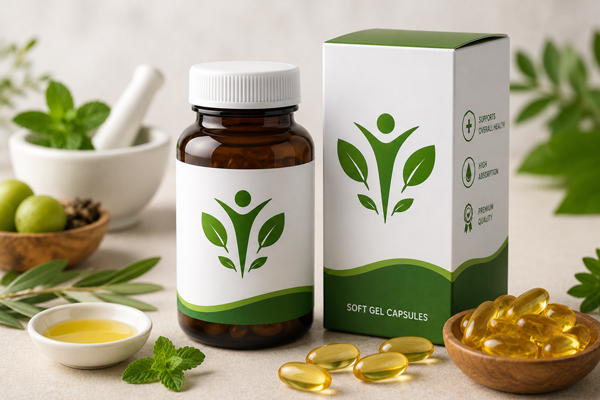
Soft gel capsules are gelatin shells filled with liquid or semi-solid contents, ideal for delivering fat-soluble vitamins (A, D, E, K), omega-3 oils, and bioavailable nutrient solutions.
Soft gels have superior absorption compared to capsules (due to liquid form) and excellent shelf life (2-3 years), making them perfect for premium supplement brands.
What Are Soft Gel Capsules?
Soft gel capsules (softgels) consist of a gelatin shell encapsulating a liquid or semi-solid fill material.
Soft Gel Structure:
- Outer Shell: Gelatin (bovine or fish-derived)
- Inner Fill: Liquid oil, solution, or suspension
- Size: 0, 1, 2, 3, 4 (similar to hard capsules)
Colors: Can be tinted with FD&C dyes for brand differentiation
Why Soft Gels for Oils?
Fat-soluble vitamins (A, D, E, K) and oils:
- Need lipid medium for better absorption
- Degrade in dry environment (powder)
- Work best in liquid/oil form
- Soft gels protect oils from oxidation
How Soft Gels Are Manufactured
Step-by-Step Process (40 days total)
Total: 40 days
Ideal Soft Gel Applications
Best For: Fat-Soluble Vitamins & Oils
- Fish Oil/Omega-3 – Most popular soft gel product
- Vitamin D3 – Fat-soluble, better in oil
- Vitamin E – Antioxidant in oil form
- Vitamin A – Retinol or beta-carotene
- CoQ10 – Fat-soluble, needs oil carrier
- Curcumin – Turmeric in oil for better absorption
- MCT Oil – Medium-chain triglycerides
- Krill Oil – Similar to fish oil, astaxanthin
Why Not Use Capsules for Oils?
| Issue | Problem | Soft Gel Solution |
| Oxidation | Oil degrads in dry form | Oil protected in sealed capsule |
| Absorption | Poor bioavailability of dry oils | Superior absorption in liquid form |
| Taste | Oil leaks, tastes bad | No leakage, no taste |
| Shelf Life | Oil oxidizes over time | Much longer stability (2-3 years) |
Soft Gels vs. Hard Capsules vs. Tablets
| Factor | Soft Gels | Capsules | Tablets |
| Best For | Oils, fat-soluble vitamins | Dry herbs, powders | Minerals, water-soluble |
| Absorption | Excellent (liquid form) | Good | Fair to good |
| Shelf Life | 2-3 years | 2-3 years | 2-3 years |
| Premium Perception | Very high | High | Medium |
| Manufacturing Time | 40 days | 2-3 weeks | 2-3 weeks |
| Storage | Cool, dry place | Cool, dry place | Cool, dry place |
| Child-Resistant Cap | Required | Optional | Optional |
Recommendation: Use soft gels for premium oil products. Use capsules for herbs. Use tablets for minerals.
Critical Testing
Quality Assurance for Soft Gels
- Peroxide Value – Measures oil oxidation (must be <5 meq/kg)
- Content Analysis – HPLC confirms actual vitamin content
- Microbial Testing – Safety check
- Moisture Content – Optimal 2-4% for stability
- Softness/Shell Integrity – Confirms proper encapsulation
- Dissolution Testing – Verifies gelatin coating breaks down properly
FAQs
Poor encapsulation or excess moisture causes leakage. We maintain strict moisture control (2-4%) and use high-quality gelatin. Leakage indicates poor manufacturing.
Fish oil (omega-3 rich) is most popular. Plant-based (sunflower, algae) is better for vegetarian/vegan. Cost differs: fish oil $5-8/liter, plant oils $8-15/liter.
That’s oxidized oil (rancid). Proper encapsulation and storage prevent this. We use enteric-coated soft gels for sensitive oils.
Traditional soft gels use gelatin (animal-derived). Vegetarian soft gels use pullulan (plant-based) but cost 50% more and have shorter shelf life.
Standard: 30, 60, 90, 120 units per bottle. Most popular: 30-60 per bottle (1-2 month supply). Higher counts reduce packaging costs but increase shelf presence.
Krill oil has astaxanthin (stronger antioxidant), more bioavailable omega-3s, but costs 3-4x more. Fish oil is standard, cost-effective. Both use soft gel format.
Yes, but they must be oil-soluble or suspended properly. Water-soluble ingredients don’t mix well with oils. Examples: vitamin D, vitamin E, herbs (if lipid-soluble).